20000
Plants Protected


By: Cynthia Lauer
When planting trees, the conventional wisdom is to space them at least 10’ apart for smaller trees and a lot more than that for larger trees. The idea is to give a young tree a starting chance by reducing competition for essential resources— water and nutrients in the soil and sunlight in the canopy.
Makes sense.
But what if there was another kind of wisdom out there? What if someone discovered that it was beneficial to plant trees far more densely than we’ve been doing? How densely? Really densely. In fact, just as densely as they grow in nature. This particular wisdom is not only out there, but it’s backed up by years of trials, research, and implementation worldwide.
It’s called the Miyawaki method.
Who was Miyawaki?
Akira Miyawaki (1928–2021) was a Japanese botanist and plant ecologist who specialized in seeding natural forests. Honouring the cultural tradition of leaving the natural forests around temples and cemeteries undisturbed, his renowned work involved the restoration of native forests for environmental protection, water conservation, and protection against natural hazards.
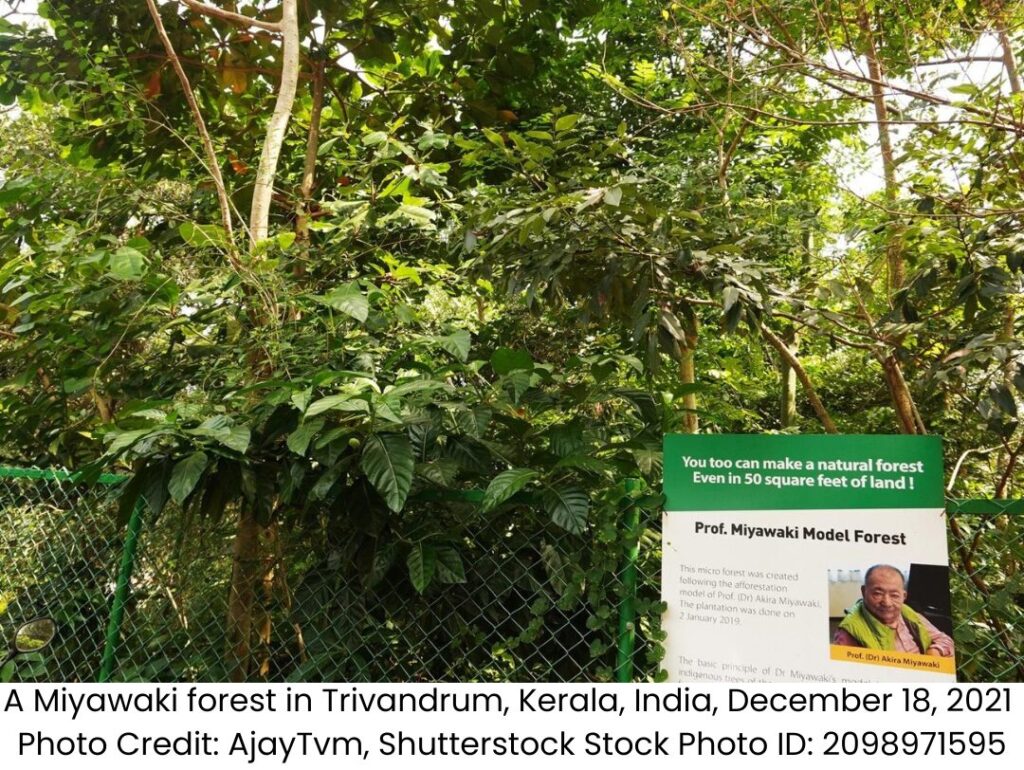
Since his earliest project in 1970—planting a forest for the Nippon Steel Corporation in Oita—Miyawaki and his partners successfully covered more than 1,300 sites with multilayered protective forests composed entirely of native species. For his work, Miyawaki won the Blue Planet Prize in 2006, the environmental equivalent of a Nobel award.
Over 1,400 of these miniature forests can be found in Japan today and over 1,700 around the world. Since 2019, SUGi, an international organization dedicated to the Miyawaki method, has planted 142 Miyawaki-inspired forests in fifteen countries including Australia, Brazil, Cameroon, Chile, France, Greece, Hong Kong, India, Lebanon, Romania, Scotland, South African, Thailand, and the US.
What are Miyawaki Forests?
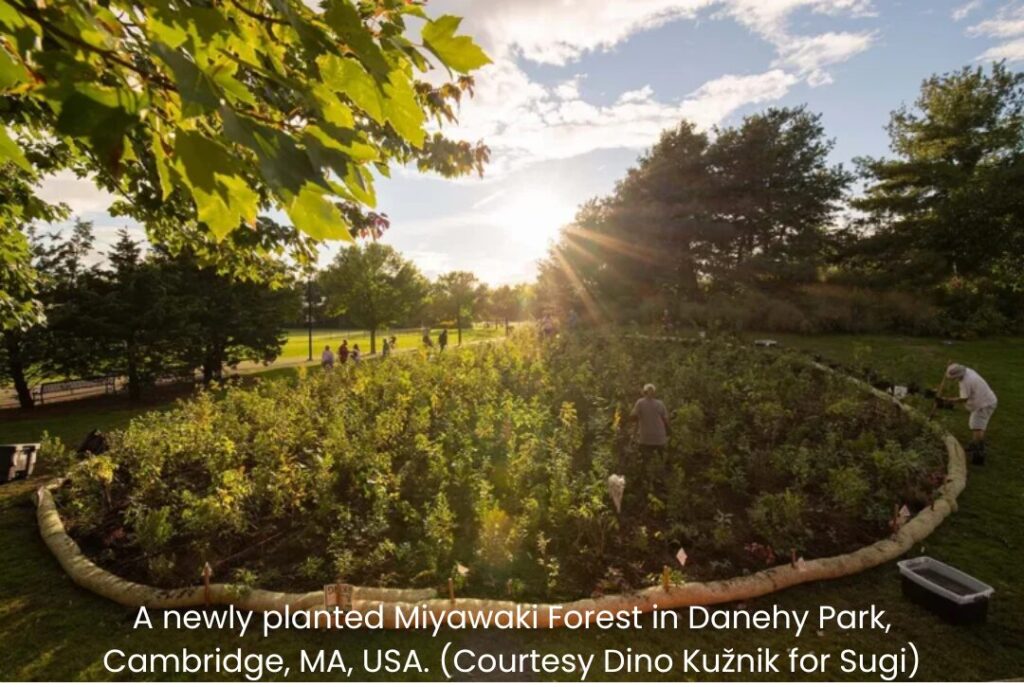
Miyawaki forests are small scale and very densely planted urban forests. A minimum of 30–50 species of trees and shrubs are selected as very young seedlings and planted at a density of 2–5 per square meter. Occupying a space the size of a tennis court, the trees are forced to share resources as they grow upward. Consisting of dozens of late succession species planted randomly into richly prepared soils, these forests consist of locally native species divided into four structural layers: (1) tall canopy trees, eg. shagbark hickory, red oak, common persimmon, black walnut; (2) sub-canopy trees, eg. alder, ironwood, pawpaw; (3) small understory trees, eg. serviceberry, dogwood; (4) shrubs, eg. black chokeberry, American hazelnut, spicebush, American elderberry. When properly done, the method quickly produces a multi-layered forest in soil whose microbial composition quickly approaches that of a typical primary forest.
The Miyawaki method replicates the regeneration process that occurs in a natural forest after a tree falls and opens a clearing in the canopy. In a Miyawaki forest, faster-growing pioneer species that often require more light will take the lead, while the slower successional species tolerant of a little more shade, will follow. Some thinning inevitably occurs and tree height is less impressive than more generously spaced trees can achieve. However, these drawbacks are offset by a faster growth rate. In as little as 20–30 years, a Miyawaki forest looks like it has been growing for 150 years. The canopy cover shades out weeds and non-native invasives and the increased leaf litter builds up fertility in the soil. If one species of tree succumbs to disease, others are sufficient in number to replace it.
Perfect for urban areas, Miyawaki forests have been installed in school playgrounds, city parks, and urban shorelines around the world. When spaces transform from non-productive wastelands of concrete to lush green biomass, human and other residents may enjoy the multiple ecosystem services that miniature forests afford. Optimal locations are dense urban spaces, monoculture lawns, or disturbed lands that attract the attention of restoration specialists. Miyawaki forests may also function as arboretums, healing forests, and food forests.
Benefits of the Miyawaki Method
With climate change, rising temperatures, and the loss of biodiversity, afforestation is critical to the continuation of life on the planet. By removing vast amounts of carbon from the air and storing it in leaves, branches, trunks, roots, and soil, trees perform carbon sequestering, an extremely effective strategy against the rise of greenhouse gas emissions.
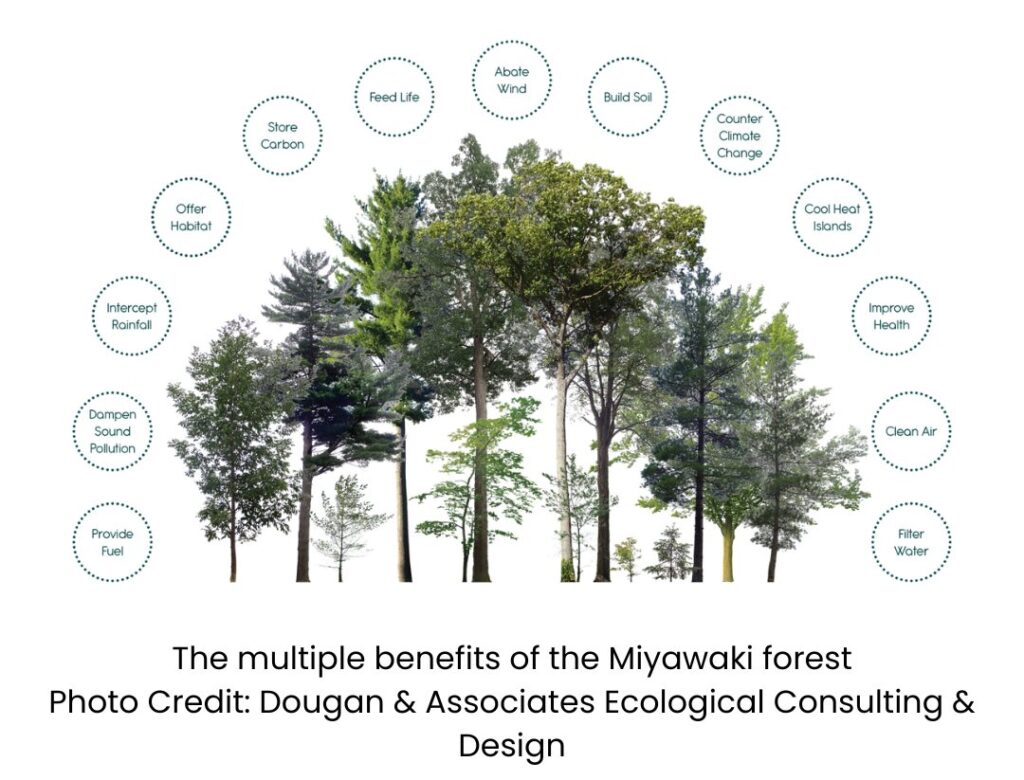
Due to their rapid rate of growth, Miyawaki forests are able to absorb 30 times more carbon than those in standard afforestation projects.
Planting small but very dense forests boosts the biodiversity of the area, nurtures pollinators, and provides refuge for birds creating wildlife corridors between non-contiguous green areas. They support and restore ecosystems, improve air quality and soil quality, enrich mycorrhizal networks, improve water absorption to buffer against flooding and erosion, and cool the surrounding area to mitigate the urban heat island effect. Studies in specific locations have shown that Miyawaki forests provide protection against tsunamis and stabilize slopes produced by mines.
In addition to their environmental assets, Miyawaki forests offer less tangible benefits. Emily Amon, Director of Green Infrastructure for Green Communities Canada, explains that “planting mini forests can have significant social impacts. They can help increase community engagement and pride, provide opportunities for outdoor education and recreation, improve opportunities for spiritual and cultural connections to nature, reduce stress, and help build social connections between community members.”
Research on the Miyawaki Method
Miyawaki published dozens of books, treatises, and articles on his research. His followers continue to expand this body of work documenting their successes with impressive before/after photographs. Here is a summary of some key findings.
Miyawaki Forests in Ontario
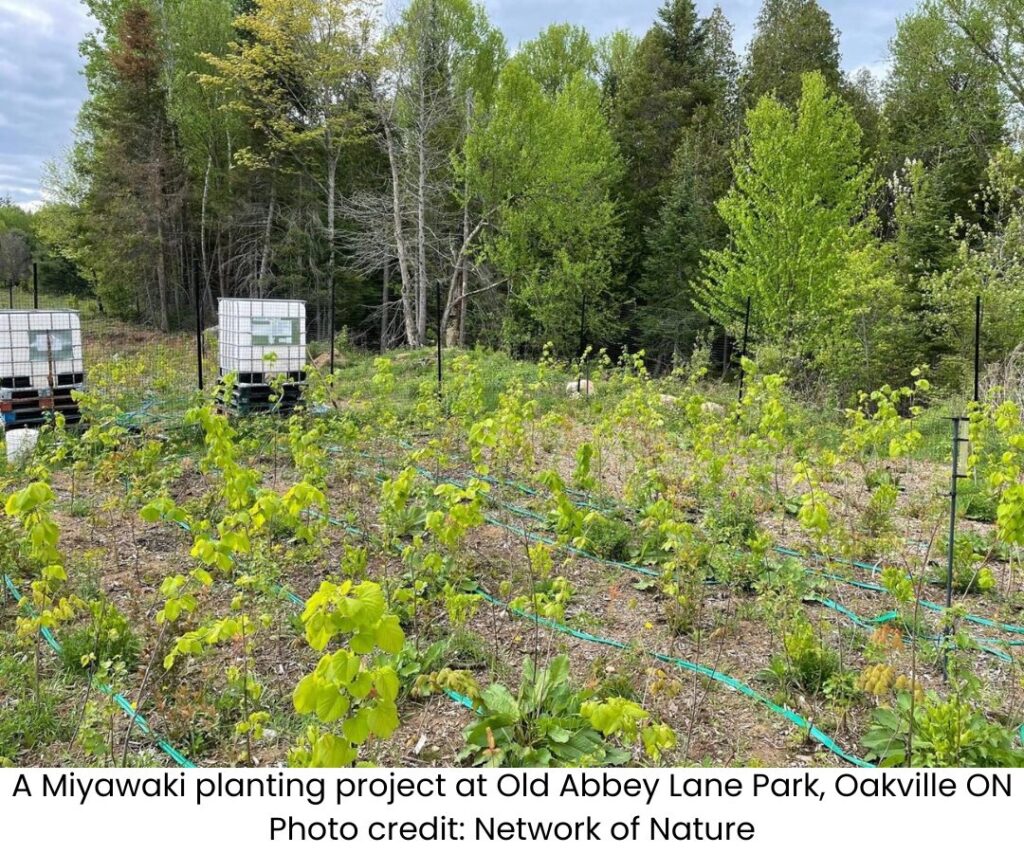
Miyawaki forests now exist in Chatham, London, Guelph, Wiarton, Dundas, Hamilton, Oakville, Georgetown, Peterborough, Lakefield, Kingston, Cornwall, and Ottawa among other locations. While examples are sparser elsewhere in Canada, Moncton, Montreal, Calgary, and Enderby, Langley, and Richmond in BC all have young Miyawaki forests.
Heather Schibli, a landscape architect at Dougan & Associates, has a property in Guelph where she has packed 230 woody plants into 72 square metres (along with a deck and a shed). The large tree species include white oak, black cherry, and shagbark hickory, while ironwood, pawpaw, Eastern flowering dogwood, witch hazel, and bush honeysuckle are some of the smaller trees and shrubs. “It is amazing how quickly other species find and utilize biologically enriched spaces. I have noticed many more insects and birds in my backyard since planting the mini forest,” Schibli says.
Although the Miyawaki method is not well known in Canada, communities both small and large are taking initiatives with it. In response to this enthusiasm, Network of Nature promotes, maps, and actively monitors new mini-forests in Canada. With its tested and wide-ranging benefits, the Miyawaki forest is an idea whose time has come.
A Living Green Barrie volunteer since 2025, Cynthia Lauer, PhD is a member of Simcoe County Master Gardeners and a regular contributor to The Gardener magazine. Her work is AI-free.